Why leadership development can, and maybe should, be uncomfortable
Something we often see in our bespoke leadership development programmes is that the most powerful moments are also the most uncomfortable. Whether it’s a leader rethinking how they give feedback, grappling with their impact on others, or trying something new in a high-stakes environment, discomfort is usually part of the journey.
That’s why, in our work with Executives and Senior Leaders, we often ask the CEO or the CPO to think carefully about how they can set the tone for the team through both their words and their actions. For example, when starting any new development programme, it’s important that the positioning lands well with the team so that people feel open to learning and developing together as a group. The introduction is often a key part of making that happen, but it’s not always easy, as it may require modelling a slightly different way of leading; one that shares more openly and acknowledges where they themselves still want to develop and learn. That, in turn, requires a degree of vulnerability.
The Stretch Zone – where growth happens
We often draw on the Stretch Zone Model to illustrate this. At its simplest, the model describes three zones and is a useful reflective tool for individuals and teams to consider where they currently sit in their role.
- Comfort Zone – familiar territory where skills and behaviours feel routine. Safe, but not where much learning happens.
- Stretch Zone – the space of challenge, learning, and adaptation. Slightly stressful, often energising.
- Panic Zone – where stress overwhelms, is uncomfortable and performance drops.
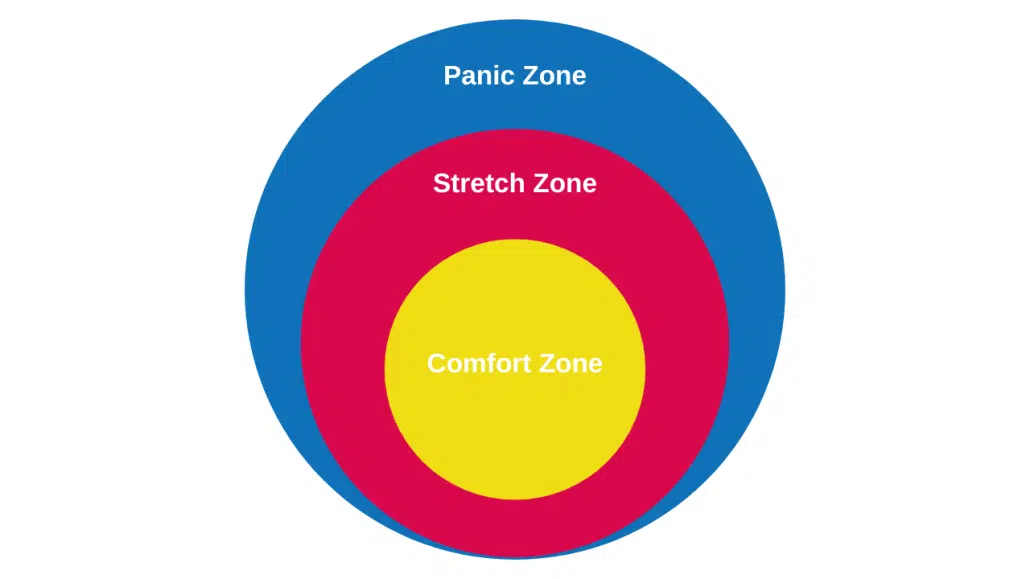
Recently, we used this model with a small team of leaders to spark open conversations about how stretched they felt in their roles. We also shared it with a group of professionals exploring career development. Some quickly saw they’d stayed in their comfort zone too long, while others recognised they were stretched and needed to rebalance.
Effective leadership development happens in the stretch zone
The stretch zone is where leaders test habits, try out different approaches, and notice shifts in how they think and act. It’s also where they realise that uncertainty, discomfort, and even failure aren’t signs they’re doing something wrong, they’re just part of the process.
This doesn’t happen by chance. A recent McKinsey study found that 75% of executives said stepping into a leadership role was tougher than expected, and almost half felt unprepared for the emotional side of leadership. That gap isn’t usually about skills or knowledge; it’s typically about experience. Programmes that create room for challenge, with the right support, help leaders bridge that gap with more confidence.
What we see in practice
In our work, some of the moments that stretch leaders most include:
- Giving honest feedback for the first time and finding the right balance between support and constructive challenge.
- Handing over control so others can step up, even when the outcome isn’t certain – ‘letting it go to let it grow’.
- Making the difficult, sometimes unpopular calls when resources are tight.
- Facing into team dynamics that have quietly held performance back.
- Hearing candid feedback on how they’re seen and taking it on board without getting defensive.
These moments can feel uncomfortable. But they also create space for reflection and adjustment, and that’s often what helps leaders become more effective.
Why it matters
Lasting change rarely happens without some discomfort. Research from the NeuroLeadership Institute shows that people are more likely to shift habits when there’s a degree of emotional intensity. That sense of unease can be the signal that something important is happening.
The alternative is ‘safe’ programmes that are heavy on content but light on challenge. They might feel reassuring, but they don’t usually lead to much change.
Our view is that leadership development should be designed for stretch as well as learning. When leaders get used to the idea that being uncomfortable is part of the process, they become more adaptable, resilient, and better equipped to lead through uncertainty.
Our role
This isn’t about throwing people in at the deep end. A big part of our role as facilitators is to create the right conditions for stretch, not panic.
That means:
- Knowing when to push and when to pause
- Reading the group and adjusting in real time
- Showing vulnerability and honesty ourselves
- Framing discomfort as part of progress, not as a mistake
Our job is to help leaders make sense of those moments, learn from them, and use them to move forward. Harvard research shows that teams who lean into “productive discomfort” outperform those who prioritise harmony, growth tends to happen at the edges, not in the middle.
So next time you feel uncertain, exposed, or slightly out of your depth in a development setting, it could be a sign you’re exactly where you need to be.
We’d love to talk about your leadership development, get in touch!